top of page
  • Jan 23, 2019
  • 4 min read

Updated: Feb 25, 2025


I love sharing lists of fairy tale retellings with readers like you! When I picked Snow White I assumed it was a more popular and well known retelling (thanks Disney!) but it wasn’t until I asked my Facebook followers for help that I came up with a sizable list.
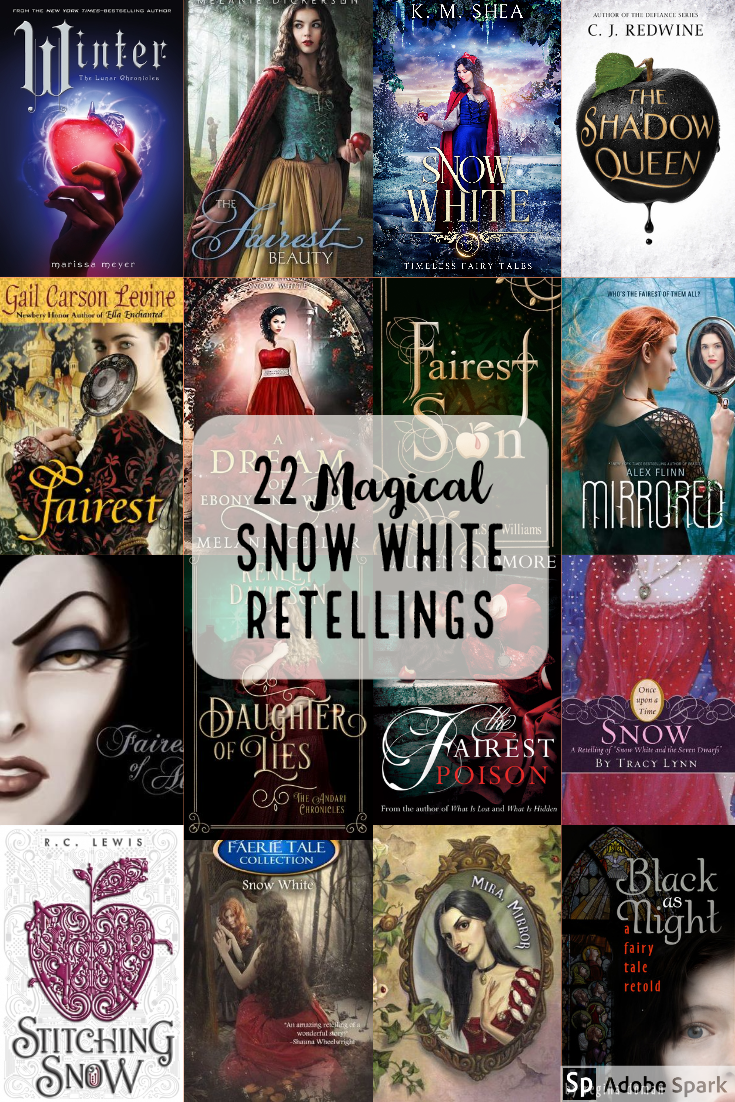


I'll start this list with some of my favorites (or really interesting takes on the well known story that I enjoyed):


Fairest by Gail Carson Levine  – I’m a big fan of Gail Carson Levine, so it shouldn’t come as much of a surprise that I love this retelling in particular. Levine is a master at pulling the heart of a fairy tale through really different circumstances, and creating worlds that are so different and yet so real. This is a great story for readers of any age, and the main character is the biggest sweetheart ever!


Snow White by K.M. Shea – Yes this is my book! 🙂 For my retelling I decided to redeem the stepmother which gives the whole story a different feel (because I figure step-parents get way too much abuse in fairy tales). But Snow White still has to flee and seeks out the Seven Warriors to help her take back her country and free her stepmother.


Stitching Snow by R.C. Lewis  – Snow White reimagined in a sci fi setting, what more could you ask for? The sci fi aspect might sound similar to Winter (see next entry) but it’s stand alone, and has more of a true sci fi feel to it than the fantasy/sci fi blend Mariss Meyer captured in her Lunar Chronicles books.


Winter by Marissa Meyer  – Winter is also a sci fi retelling of Snow White–though it does have more of a fantasy flavor to it as well. Unlike Stitching Snow, it is the fourth book in a series, Lunar Chronicles, and I would highly recommend you read books 1-3 first! (Particularly because Winter is the final book, ahah.) Lunar Chronicles as a series is really interesting and fun, not just because of the futuristic twist to it, but because each book as a different fairy tale focus, but you still see the girls from the previous books!


Pretear by Junichi Sato and Kaori Naruse – This entry is probably going to surprise some of you since I know many of you don’t read Japanese manga. 🙂 But it is a retelling of Snow White, and it’s actually a more faithful adaptation then many of the other books in this list. It follows the story of Himeno, a high school student who finds out she has special powers when seven “knights” show up to help her defeat the darkness attacking her town. There is also an anime series but the manga is MUCH better!

As I mentioned at the start, I asked the readers who follow me on Facebook for more suggestions and here is what they came up with! (I asked for no spice and low language recommendations but check reviews if that is a concern for you.)


The Shadow Queen by CJ Redwine

The Fairest Beauty by Melanie Dickerson

Mira, Mirror by Mette Ivie Harrison

Snow White by Jenni James

Fairest of All by Serena Valentino

A Dream of Ebony and White by Melanie Cellier

Mirrored by Alex Flinn

Blood in the Snow by Sarah Pennington

Fairest Son by HSJ Williams

Vanity by Sonya Writes

The Fairest Poison by Lauren Skidmore

Shadows on Snow by Starla Huchton

Daughter of Lies by Kenley Davidson

Mirror, Mirror by Jen Calonita

Hunted: Alba's Story by Kaylin Lee

The Fairest Heart by Heather Chapman

Song of Ebony by Deborah Grace White

The Poisoned Prince by Kristin J Dawson

Once Upon an Apple by Gabrielle Landi

The Huntsman's Heart by Brittany Fichter

Poisoned Heart by Abigail Manning

Frost Gate by Hanna Sandvig

Mirrors and Pearls by Lea Doue

Winter Cursed by Nicki Chapelway

Mirrors and Magic by Laura Greenwood

Tear You Apart by Sarah Cross

Reflection by Camille Peters

Fairest One by Kayla Eshbaugh

Pure as Snow by Laura Burton and Jessie Cal

The Mirror and the Curse by J. M. Stengl

To Rival a Reflection by Selina De Luca

Poisoned at Dawn by Leialoha Humphreys

A Fairest Hope by S. Lee Poole

Capturing the Heart by Faith Brown

No One Fairer by Alice Rosegold


So what is your favorite Snow White retelling, and why? (And what retellings did we miss in our list?)


If you'd like to read fairy tale retellings focused on the other Disney Princesses (and more!) I have a whole series of blog posts you can check. Click here to start reading or use the Book Lists category to filter them.

 
  • Jan 14, 2019
  • 4 min read

Updated: Mar 25, 2025

As most of you know, I like to base my countries off real life (Historic) countries from our world. Loire and Trieux both have French roots, Sole is more Italian, Ringsted is Scottish/Irish, Farset has more of a celtic vibe, Kozlovka is Russian, and Verglas is more Norwegian.

The problem is I usually try to use lore from that particular country when I build the story, but Snow White–like Wild Swans–is solidly a German folktale. (There are variations, as we already explored, but the Snow White story as we know it is German.) I knew I needed Arcainia to be more of German influence due to Wild Swans, so what was I to do with Mullberg?


I was aware of this problem back when I was first designing the story world which is why I decided to make Arcainia and Mullberg neighbors. As neighbors its more understanding that they would share a similar German culture–much the way Trieux has/had a very similar culture to Loire.

You can see the similarities in the way the royals are unafraid to work, and are more aware of their subjects’ daily lives than the more affluent countries like Loire and Sole.


But I also needed a way to depict clear differences. And let me tell you this was a real challenge considering Snow White spends about 80% of the book IN THE FOREST. But I still tried to place clues, so let’s talk about a few!


First, you can see the German influence in Mullberg clothes. I very specifically mention that Snow White and Faina wear dresses with small puffs at their shoulders and elbows, complete with ribbing. This is a veeeerrrryyy German dress style, as you can see below.

This fantastic drawing was created by Clair Hummel (You can find her at: https://www.clairehummel.com/illustration )


I also used Germanic names (Fritz, Marzel, Wendal–all the warriors have German names, yes, including Aldelbert–though his comes from the name Adelbert, I threw in the extra L because Aldelbert is the sort of guy who needs it.)


Where Mullberg starts to depart from both Germanic tradition and Arcainia, is in the formation of the government. Mullberg is unique in that it has a Cabinet of lords who serve to help the monarch make decisions.

Other countries have royal advisers, but none with as direct access as Mullberg’s cabinet. Moreover, Mullberg royalty is the most informal in the continent–even more so than Baris.


There is multiple examples of this through out the book–from the servants speaking freely to Snow White to the fact that the Seven Warriors don’t bother much with Snow White’s title. You can even see it in the way Fritz doesn’t dwell very much on the improbability of a princess falling for a forester. (Isaia, on the other hand, agonizes over this since he is from a land of nobles and blue bloodlines, even though he is of noble blood.)

Probably the greatest example of this, however, can be seen in the meeting with Lord Vitkovci and the other lords. The lords don’t protest Snow White staying with the Seven Warriors because it’s beneath her to room with peasants, they’re only concerned about her reputation.

Besides Mullberg’s distinct culture of informality, there is another unique trait to this country: mining. This I took directly from the original Snow White where, as you might recall, the dwarves are all said to be miners.

Though Snow White mentions that Mullberg’s biggest industry is mining, if you pay close attention, you can see that play out in Mullberg’s culture. (And I mean clooooose attention, because it is HARD to show that off when the heroine spends the bulk of the book in a forest.)


It starts in the palace. If you read the first chapter closely, you’ll notice considering it’s a little more humble than the other countries (being that it doesn’t follow Loire fashion or influence) the palace has a lot of jewel encrusted decorations. Heck, Faina uses a giant gem as a paperweight and no one thinks twice about it.


I also made a nod to it in the capital city’s name, Juwel, and the palace’s name, Glitzern (like glitz and glamour) but where it’s especially hidden is in Hurra. Hurra is a moderate city–given it’s close proximity to the capital there is no need for it to be huge. And yet in her short visit there, Snow White sees multiple jewelers and jewel smiths–something no country besides Mullberg would have the ability to support because the industry just simply isn’t there.


It’s a little more obvious when the Seven Warriors choose to take on the disguise of miners, but you can also see it in the palace decorations at the end of the book as well–there is again more gold and gems and different types of rock.


So that’s Mullberg! It was a really fun country to play in–particularly because of its informality. I hope you enjoyed today’s post, Champions, thanks for reading, and have a lovely day!

 
  • Jan 7, 2019
  • 3 min read

Updated: Mar 26, 2025


Snow White is a little difficult to extrapolate the moral, mostly because the majority of fairy tales summarize the moral in the last few lines of the original tale. (In example, Cinderella and the Snow Queen.)


But let's give it a try!


Of course, you can pull the traditional moral that a lot of fairy tales underline, and that is that the world is big and can be scary, and you shouldn’t blindly trust strangers–which is admittedly one of the morals in Snow White. (Hansel and Gretel and Little Red Riding Hood are both examples of this moral as well.)


But perhaps the moral closest to the core of the story is vanity. The wicked queen/stepmother starts harassing Snow White because of Snow White’s beauty. Even though the princess has to be half her age, the queen is obsessed with being the fairest in the land and remaining young and beautiful.


What is the saddest part about the queen’s actions, is that she clearly believes her only worth as a person is in her beauty. This is a devastating thought, and though I’m probably reading into it, it seems unlikely this is a belief the queen came up with on her own without any sort of outside influence.


(As a side note, I abhor this kind of thinking. That’s why a lot of my heroines might be pretty, but often it is in an nontraditional sense. Gabrielle is the most beautiful of all–Angelique withstanding–and she HATES her beauty at the start of her story, and still doesn’t see any value in it even now as a crown princess.)


Back to the moral, it is the queen’s obsessive vanity that turns her into a cannibalistic murderer, and it is the queen’s vanity that ends her life.

You can see my tip of the hat to this moral in the way Faina acknowledges she is vain. (The mirror would have taken a long time to conqueror anyone who didn’t give two hoots about their looks because in order to influence a victim, the victim needs to be THERE.)


But while pointing out the folly of vanity is a worthy moral, I decided I didn’t want that to be the theme in my Snow White, and instead I decided to explore something that I’ve noticed is a vacuum in fairy tales: parental love.


In the majority of fairy tales, the parents are either incompetent (Belle’s father from Beauty and the Beast or the father of the heroine from Rumpelstiltskin) dead (Swan Lake, Cinderella’s mother) or absentee. (Cinderella’s father, Snow White’s father, etc.) In the few cases they are present and somewhat good parents–like Snow Queen–they are obstinate and oblivious to the heroine/hero’s struggles. Sometimes the parents are even villainous themselves. (Hansel and Gretel’s parents.)


I understand why–a major theme in Fairy Tales is encouraging children to grow up–but do ALL fairy tales have to follow that pattern?? Truly?

Since I first started planning this series I knew I wanted to delivery a great big wallop to that common thread, and deliver a story in which a parent sacrifices everything to protect their child. Even better, I wanted to use one of the most common fairy tale villains: a stepmother.


Queen Faina–Snow White’s stepmother–changes the future of the continent because of her stubborn love of Snow White. If she had given in sooner, or allowed the mirror to kill Snow White, it would have created a devastation that would have rocked the world.


While Snow White moves her court to save her stepmother, it is Faina who is the true hero of the story, for in her refusal to hurt her stepchild, she saved the continent from certain disaster. And that is the kind of love parents–or step parents, adopted parents, or even mentors–have for their children, the kind that shapes the world.


You can see echos of this not just through Faina, but characters like Empress Sonya of Swan Lake, Grandmother Guri, Cinderella’s stepmother, Rothbart, and Sybilla. (Yes, though Sybilla has no children, her love for Angelique is something of a saving grace for the enchantress-in-training.)

So, that’s my moral! It made for a rather different rendition of Snow White, but it’s also why I have a soft spot for Mullberg. Thanks for reading, Champions, and have a lovely day!


And if you're interested in reading my retelling of the Snow White fairy tale you can get my standalone story in Kindle Unlimited, or ebook / paperback!


Recent Blog Posts:

bottom of page